Archive for February, 2010

Growing Potatoes, vertically!

February 26th, 2010

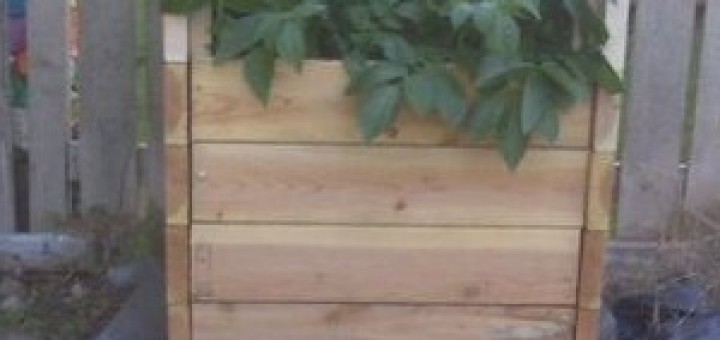
Vertical Potato Bin, photo by Sinfonia

This year, we are trying something new in the garden, POTATOES.   Given that potatoes are cheap and readily available at the store, and they can be easily purchased from a local source year round, Why Potatoes?

  1. Amy loves potatoes, 
  2. It involves an interesting new growing technique where we will encourage growth all season by growing vertically, 
  3. Because we can.
  4. There is some concern that potatoes, since they are a root vegetable, have a greater risk of picking up nasty chemicals from overfertilized or polluted soil.


So, what’s this about growing potatoes vertically? 

It’s rather simple, really.  A potato plant will produce significantly more potatoes in the same Square Foot area if you add soil upwards as the season progresses and the plant grows taller.  Production can go up significantly; there are claims of up to 100 pounds of potatoes in 4 square feet of growing space.  (I suspect that the planty stem of a potato can send out roots when it comes into contact with additional soil, just like tomato plants.  Both potatoes and tomatoes are in the nightshade family.)

We are going to dedicate 16 square feet, and I would be thrilled to see 100 pounds of potatoes in that larger area, that’s just 1/4 of these enthusiastic claims.  (Important note: Early potato varieties set production once for the whole season, so you would only get one thin layer of potatoes underneath a deep pile of dirt.)

We will be dedicating one of our ten beds to this project.  The bed itself is 7″ deep, but I have already built one 7″ riser which will stack on top.  The riser and bed follow my Modular Raised Bed System for Square foot gardening.  I will have to build a few additional risers as the summer progresses, but I may build them with scrap lumber instead of buying fresh cedar decking to save money and resources.  (Since the soil will only be in contact with the wood for a few months, rather than year round, I expect even untreated pine would last several years in this method.)

I will be ordering “Yellow Finn” variety seed potatoes from Seed Savers Exchange.  A 2.5 pound bag of seed potatoes (10$ + S/H) is described as enough for a 25′ row, so I think it will be more than enough for 16 square feet.  I may be able to share if someone is interested.

Links:

A living room jungle

February 24th, 2010

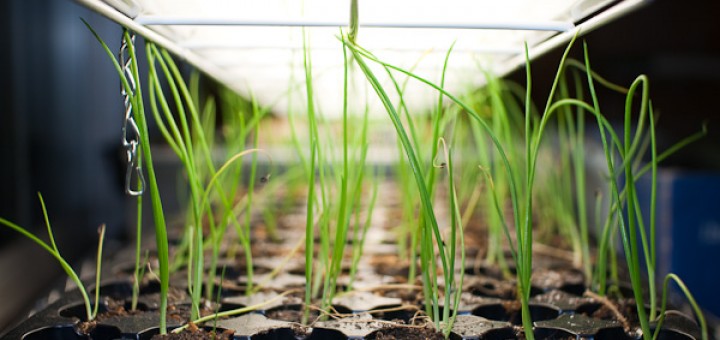
These enthusiastic onions under supplemental light will get planted out in March. (This flat includes green onions, walla walla onions, shallots and leeks)

Our starts are doing well.  We now have two shelves filled with plants which just keep on growing.  I have begun to acclimate a few hardy plants such as lettuce and leeks.  They will spend part of the day outside under a plastic dome.  After about a week where the outdoor time is increased every day, they will be ready to plant outside.  This is called “hardening off” the plants.

Tomatoes and Basil plants nearing 6 inches tall.

As for the less than hardy plants such as tomatoes and peppers, they keep on growing indoors too.  My largest tomato plants are about 8 inches tall, as they approach two months old.  I think that they will need to be replanted in larger containers atleast once before they can go outside for good.  Although it pains me to admit a mistake, January 1 is clearly too early to start your tomatoes.  They will probably be fine if I transplant them into a larger container before they get root bound, but they will be extremely large by May.  I am curious to see how much more production I get with extremely established starts like this.

Sage develops it’s characteristic crinkly leaves within a month. (left)  Peppers germinate and grow slowly but surely.  They might benefit from supplemental heat. (right)

Celebrating “Spring Fake” 2010

February 8th, 2010

Just as the east coast has gotten pummeled with 30 inches of snow, a false spring has struck Seattle.  On our walk today I saw many signs of  spring including small tuliplike flowers, greener grasses and the smell of sweet jasmine flowers even though we couldn’t find the source.   

The warmer weather has confused the garden as well.  Today, I discovered that the hop plants had set new runners, just breaking the surface in the last day or two.   The winter garden has picked up a good deal too.   The reasonably tough Speckled Lettuce has set new leaves after losing some of it’s larger leaves to the colder weather in December and January.  The Onions and Garlic are still doing very well; if this keeps up we will see an early harvest.  The snow peas which I planted two weeks ago on a whim actually sprouted in the last few days.  (I am using shredded newspaper as a free, no-impact mulch to insulate and warm the soil.  It is a great way to extend the season.)

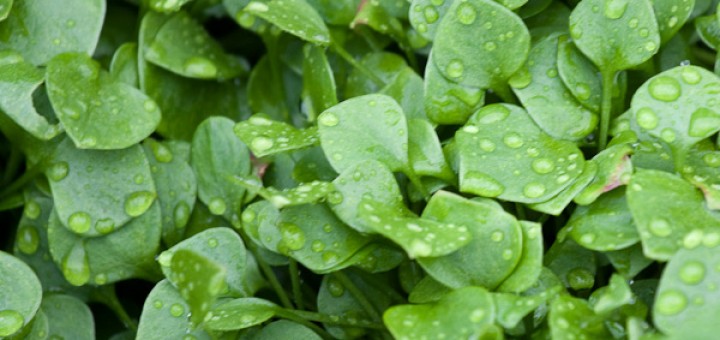
Snow Peas breaking ground level (left), Miner’s Lettuce (right) is doing very well as an unprotected winter crop.

Miners Lettuce is a new crop for us.  It is similar to lettuce, but grows in much colder weather.  It has flourished this winter with no protection, giving us small leafy greens to supplement our winter diet.  I have added it to store bought salads, added it to stirfry and pasta for a splash of green and used in place of lettuce when making a sandwich.  A northwest native plant, it was named Miners Lettuce as it was eaten by prospectors in this region to fend off scurvy.  The flavor is similar to lettuce, mild, if slightly nutty, and a little crisper.

Hops trying to grow a little too early.

 Shallots are a multiplier onion.  You plant one shallot in the ground, and up to 8 plants grow from a single bulb.

The indoor starts are also doing very well.  I had to put one light fixture on each schelf as it slightly increases the number of plants getting supplementary light.  I may have to get one more fixture when all the young tomato plants move into the 3″ squares.  I will have to give an update on the starts soon!