Archive for the ‘Board Games’ category

Finally, the perfect game for my Phone.

March 3rd, 2010

Everybody seems to be getting a touch-screen phone these days.  They are generally able to make calls, browse the web, play games and more.  In my case, I have an iPhone, and I primarily use it to read my email, check my calendar, read facebook or browse the web.  I have lots of free games, but hadn’t found any games that really engaged me.

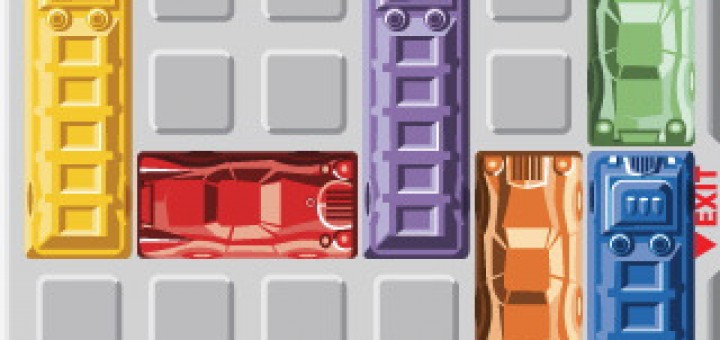
Rush Hour is a simple puzzle game that I have seen for years in toy stores and game shops.  It has a simple premise, you need to solve challenges where you arrange the plastic cars on a grid as indicated on the challenge card.  Then, by only moving the cars forward and back, you need to free a path for the red car to slide out of the traffic jam.  It’s basically a 2d mashup of  a Rubik’s cube and Tangrams.  It’s deceptively simple to learn, but the trickiest challenges take some time.

I realized this would be a great iPhone game right when I got the phone and tried an assortment of free games.  Many were fun, but very few kept me engaged for more than a few minutes.  Rush Hour seemed an obvious game for the touchscreen device, but when I looked, it wasn’t available.

Thankfully, they have realized the opportunity and made this time killer available for the Phone.  A free version offers a couple hours of enjoyment, and the pay version promises many more challenges.  I like how the game tracks your movements and you can try to solve the puzzle with the fewest movements if you like.  

Phone adaptations of more complicated games I enjoy such as Settlers of Catan enver made any sense to me, I don’t play board games to have a private experience on a small screen, I play to have a fun time with friends.  Games for the phone should be easy to pick up, easy to stop anytime and fun.  Rush Hour has met all of these goals.   It makes bathroom time and time spent waiting around much more fun!

The secret life of a board game geek…

January 27th, 2010

It’s true, I am famous on the internet!  To see how, you need to read further…

As noted in my recent article, I love board games!  One thing I didn’t have time to go into in that article are the many ”expansions” that have come out for many popular games.  Expansions breathe new life to a familiar game by adding new rules and generally add new game components such as advanced pieces, or a new map.  They generally increase the length and complexity of the game they expand, and they vary from a few dollars for a few cards and new rules, to nearly the same price as the game they expand.

As much as I love board games, I am addictied to expansions!  This is despite the fact that they rarely provide significantly more fun than the original game itself.  It’s worth calling out a few ppoular games to see how their expansions extend the gameplay experience:

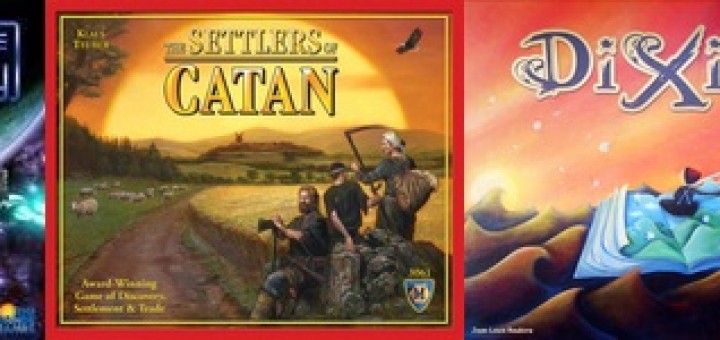
  • The Settlers of Catan is the archetypal mainstream eurogame.  It has as many reissues, expansions, and spin-off games with similar rules as any other game.  The most famous expansion for this game is the Cities and Knights of Catan, which is on the higher end of the scale in terms of added complexity and cost.  It turns a game which can frequently be completed in around an hour into a game which frequently takes 2 hours or more.  I really enjoy this expansion, but it is practically a whole new, more complex game based on the idea of the original.  This is a good example of a large expansion which makes you really rethink your approach to the game.
  • Race for the Galaxy is a recent card game.  As I noted in my earlier article, it is complex to learn but fun to master.  It has two expansions so far, both adding relatively little new material and rules.  Unfortunately, the expansions are pretty pricey for what they add.  The first expansion, The Gathering Storm, simply built on the rules of the original, providing a little more options for growth, without changing the formula for success.  The second expansion,  Rebel vs. Imperium, added new attack mechanics which changed the tone of the game and increased the complexity a good bit.  Overall, both are examples of mid-sized expansions which evolve the game by adding new ways to win, without breaking old techniques.
  • Ticket to Ride is a fantastic game which has been recreated several times as a complete new game based on the original rules.  Spin-off games in the series include Ticket to Ride Europe which is the only edition we own.  Both the original game and the Europe edition have seen relatively small expansions (ex: Ticket to Ride: Europa 1912) which keep the original rules and map, but replace the destination cards used when playing the game to mix things up.  These small expansions often offer the least value despite their low cost since they only change the game in minor ways.  (That said, I don’t have Europa 1912, and I do look forward to getting it and being pleasently suprised.)

One of my favorite games, also turns out to be the king of expansions and spin-offs; Carcassonne.   It’s simple design and modular tile-based gameplay is easy to extend and reimagine. Carcassonne has seen 6 mid-sized expansions, 8 small expansions, 7 spin-off games (one is for children) and a card game only tied to the rest of the series by name.  I had collected every expansion and spin-off in the series until recently, when they released a poor game and a poor expansion in the series the same year.  The expansions alone are difficult to keep organized, since they all consist of square tiles which are difficult to distinguish from one another.

Tuckboxes?

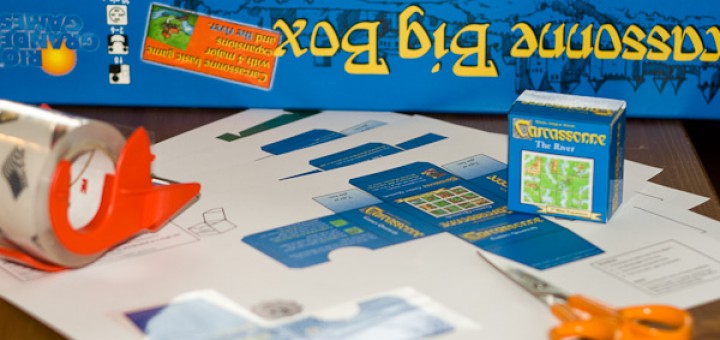
This is why I am famous, if only amongst a small number of board game enthusiasts on the popular Boardgamegeek website.  To aid in my own organization, I designed a set of printable “tuck boxes” that store the tiles from one expansion so I can keep them separate from other expansions and the main game.  I designed boxes for a few of my favorite expansions quickly in PowerPoint, printed them on cardstock using a color laser printer and then folded and taped them into perfect little boxes.  Pleased with my work, I shared them with other Carcassonne players.

Assembling a Printable Tuckbox for Carcassonne which I designed.

What followed after sharing them on the web is a little strange.  I started getting emails from folks who found my tuckboxes on the web like the following:

I already have several your boxes (for the Cathars, River, the 3rd expansion, the 5th)
I would like you to ask for the others, do you have boxes for the 1st, the 2nd, the 4th

and…

I would like modify it so I can create my own tuck box for a different expansion.
When I updated the tuckboxes to include another expansion, I added a note indicating that I would like to locate a copy of the carcassonne expansion The Cathars, which was release several years earlier with the german gaming magazine Spielbox.  It wasn’t broadly available anymore, except on ebay for 40+ dollars a copy.
 
A short time later, I got an email from a generous gamer who loved my tuckboxes and offered me his extra copy of the Cathars and the Spielbox magazine for 10$ shipped.  I was amazed by his generosity, and the fact that someone appreciated my work enough to give me a special deal on a difficult to locate item:
I saw in your tuckboxes from boardgamegeek.com that you were wanting a copy of Cathars.  Are you still looking for one, or is this old information?
I have all of your tuckboxes, in fact, and use them to be able to store the entire game in the orignal box, which would be impossible otherwise.  …  I particularly like how you have put the expansion name on the top flap, since that is how I store the boxes in the main box.
If that wasn’t strange enough, there is a community of Carcassonne enthusiasts who are constantly producing fan-made expansions to the game.  I was contacted by one member of that community who wanted to use my templates to create tuckboxes for his fan-made expansions.

Tuckbox for a fan-made expansion made by someone else based on my design.
 
I have continued to get ideas, requests, thanks and general appreciation for my work via email and the boardgamegeek website.  It always makes me smile when I get another friendly message for my work. 
The latest addition to my Carcassonne tuckbox collection for the Tunnel expansion which came out in the fall.
 
So far, my collection of tuckboxes have been downloaded over 4700 times.  Yesterday, I released an update to the tuckboxes to include the latest expansion, The Tunnel, even though I don’t have a copy yet.  Only time will tell how the Carcassonne francise will grow, and  if I will be able to keep up with the never-ending expansions!
As always, if you found this interesting or have a question, please leave a comment on my blog or send me an email: tom (at) tomalphin (dot) com

Board games that aren’t boring.

January 17th, 2010

I love board games!  Most of our favorite board games are fun to play, take around an hour to complete and are easy to learn.  Most of the games we play are broadly categorized as “german-style” or eurogames, which are generally designed for families or casual groups, and the focus of these games is usually to outperform your opponents, rather than directly interfere with them.

I enjoy games which contain a balance of tactics (making the best move right now) and strategy (making a move which doesn’t help me as much now, but helps me even more in the long run).  I tend to lose interest when a game is too biased towards Tactics, and I get frustrated when a game is too heavy on Strategy, as it can cause players to take really long terms as they consider all of their options and their long-term ramifications.  One of the best resources to learn about board games is the Board Game Geek website. (boardgamegeek.com)  Once you find one game which you like, it easy to find others you might enjoy by reading their detailed reviews and ratings.  You may also be able to find stores in your area that specialize in this style of games.  Their staff is generally very good at helping customers select a game they might like, and some stores have an open copy of the most popular games, so you can try before you buy.

A few of our favorite games:


Ticket to Ride is very easy to explain, but difficult to master. The game is played on a map with cities connected by possible rail routes. You start the game with tickets, each containing two cities which you are trying to connect. You connect the cities by laying town track between cities. You pay for the track by collecting resource cards of the corresponding color. The game ends when the first player runs out of track, and the player witht he most points from track and completed tickets wins.


Carcassone is a fast paced game where each player in turn adds a tile to the countryside, laying claim to fields, roads and cities as they go. As these features get completed, players earn points, and the highest score wins.


Settlers of Catan started the eurogaming revolution here in the US. It is a fairly complex game to teach, but once you get the hang of it, it can be a lot of fun. You begin with two settlements which are surrounded by the resources grain, brick, wood, sheep and ore. Each resource has a die roll associated with it, and you get resources when the corresponding numbers are rolled. You use resources to compete for roads, additional settlements, cities and more. The player who earns 10 points first wins.


Race for the Galaxy is actually a card game, abeit a complicated one. In this game, you are competing to control the galaxy by establishing settlements and developing enhancements to your operations. There are many different ways to succeed at the overall goal whihc is to have the most points, and in most games you employ more than one strategy. A complicated set of rules and symbols make this game particularly difficult to learn, but the great variety of strategies has kept us coming back after more than 60 games.

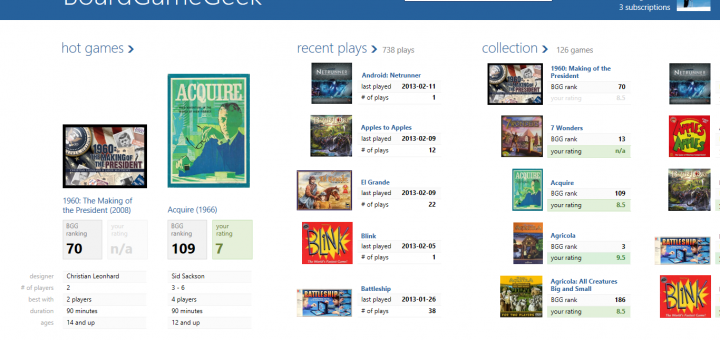
These are just a taste of the interesting games that are out there.  If you are interested, you can see all the games I own and most of the games I have played by finding my page or my collection of games on the BoardGameGeek website.